
TOPIC 2.13 Resistance and Revolts in the United States
Gabriel, Denmark VESEY, & Literary Archeology
LO 2.13.B Describe the inspirations, goals, and struggles of different revolts and abolitionist organizing led by enslaved and free Afrodescendants throughout the Americas.
“He did not see the other 25 men in his party executed. Instead, he saw Monroe in an audience he wanted no part of and paid little notice to. For Gabriel Prosser the blacksmith, leader of men and accepting no master’s name, had stepped into the troubled water. To the very last, he was whole. He was free.” - Barry Jenkins, “Gabriel Prosser,” 1619 Project, 2019
"I know Denmark Vesey…(he told me) we are free but the white people here won't let us be…At this meeting Vesey said we were…to get arms; that we ought to rise up and fight against the whites for our liberties; he was the first to rise up and speak, and he read to us from the Bible, how the Children of Israel were delivered out of Egypt from bondage.” - Rolla, an enslaved man. Court confession as recorded by the government of South Carolina, 1822
Objective: Students will analyze how gaps in historical records obscure Black humanity and interior life and then write creatively and critically to explore truths about the emotions and motivations of Denmark Vesey.
Overview
This lesson invites students to step into the role of literary archeologists, inspired by Toni Morrison’s idea of uncovering “truth” beyond the limits of historical documents. In her essay The Site of Memory, Morrison describes how enslaved peoples’ interior lives were often erased from the historical record. To reconstruct these lives, she writes, we must use imagination alongside evidence: “The crucial distinction for me is not the difference between fact and fiction, but the distinction between fact and truth. Because facts can exist without human intelligence, but truth cannot. So if I'm looking to find and expose a truth about the interior life of people who didn't write it. (or for whom history would not allow their inner truth to be recorded.)”
Following this model, students will explore an expert modern writing example about the story of Gabriel Prosser’s Rebellion from Barry Jenkins in the 1619 Project and then students will investigate the story of Denmark Vesey and create their own historical fiction. Students will engage with primary sources, examine silences and biases in the record, and write to reveal the humanity and complexity of historical actors.
I have already discussed Gabriel’s Uprising before the lesson so part 1 of the lesson below only take me about 8 minutes of class. I allow students to volunteer to read the short story. Gabriel’s Uprising is alluded to in a 2.12 required source (Thomas Jefferson’s letter). If you haven’t introduced Gabriel yet, I have included two other primary sources in the handout link that students can explore before reading Jenkins. This way, students get a feel for how an author draws on the historical record to create a piece that potentially reveals more truth about Gabriel’s final thoughts and emotions than James Monroe’s Letter.
Lesson Flow
Print the handouts (back-to-back) for all students.
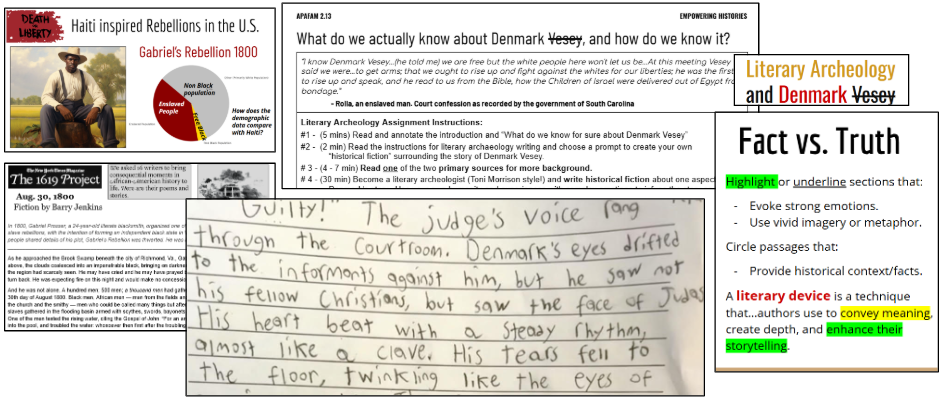
Historical Fiction Example: Barry Jenkins on Gabriel’s Rebellion (8-30 minutes depending on your unit pacing)
The lesson begins by examining a contemporary example of historical fiction: Barry Jenkins’ essay in The 1619 Project about Gabriel’s planned 1800 uprising in Virginia. Students compare the narrative strategies used by Jenkins to convey emotion, motivation, and humanity, and discuss how his “historical fiction” may reveal more truths about enslaved people’s interior lives than traditional primary sources, such as letters written by James Monroe. This sets the stage for understanding Morrison’s lens: rather than seeing a simple fact vs. fiction dichotomy, students explore how gaps in the record obscure full Black humanity.
Introduction to the Denmark Vesey Writing Assignment (5 mins) Following Morrison’s lens and Jenkins’ example, students will explore the story of Denmark Vesey and create their own historical fiction. I complied a list of facts that historians generally agree on about the Denmark Vesey’s background. Student should read and annotate the list of facts from the section called “What Do We Know for Sure About Denmark Vesey?” Allow students a minute or two for questions if necessary.
Primary Source Exploration (4–7 min) – Continuing in a whole group structured setting, instruct students to read one of two primary sources about the Denmark Vesey story.
a. An Official Report of the Trials of Sundry Negroes (Charleston, 1822)
b. Excerpt from Anna Hayes Johnson’s letter (July 18, 1822)
Write Historical Fiction (30 min) – After students have examined one of the two primary sources, it is their turn to become a literary archeologist! The directions instruct students to “infuse your story with humanity, emotion, and perspective to reveal truths that primary sources cannot fully capture.”
Optional Writing Prompts:
A Debate in the AME Church: Imagine church members debating whether to risk an uprising. Explore fears, hopes, and ethical dilemmas.
Courtroom Scene: Reconstruct Denmark Vesey’s trial with vivid dialogue, emotions, and atmosphere.
Denmark and His Wife: Write a conversation between Denmark and Beck Vesey as they grapple with the decision to lead a rebellion.
Alternative Letter Writing Options: Respond to Anna Hayes Johnson’s letter from the perspective of a different historical actor (e.g., a friend of Beck Vesey or a white abolitionist like the Grimké sisters).
After reading student examples, I select my favorite lines from about ten submissions and distribute them to the class for a future “Do Now” warm-up activity. Students then choose the “golden line”—a favorite line that stands out—which we use as a simple discussion device for analyzing literature and poetry. Only after the class reaches a consensus do I reveal the author of the golden line. This is a simple and fun way to celebrate student creativity.