
Topic 2.8: The Social Construction of Race and the Reproduction of Status
The Creation of Race Timeline Activity & Discussion
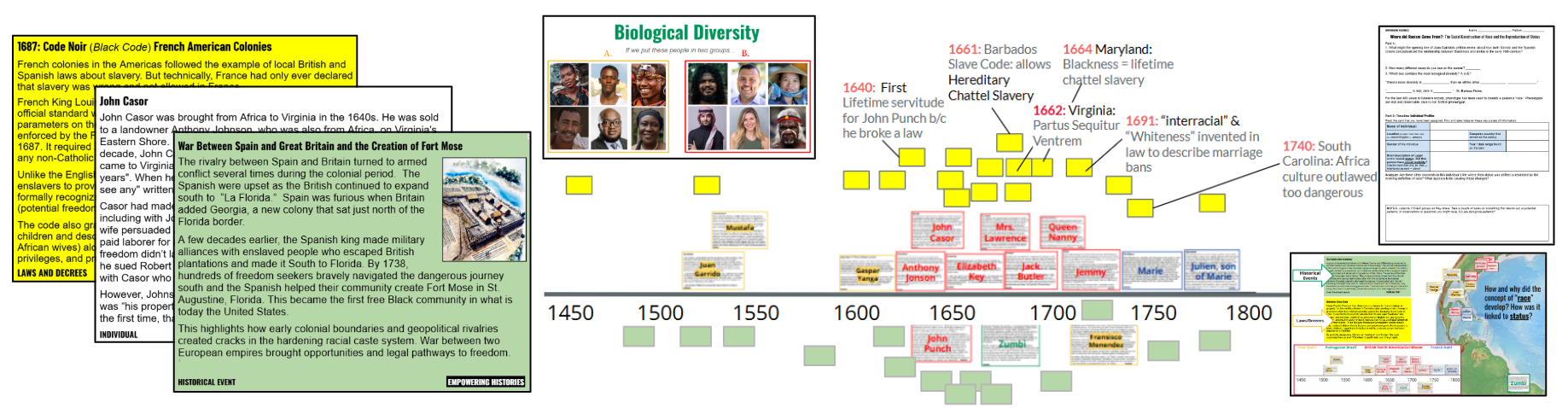
LO 2.8.A - Explain how partus sequitur ventrem affected African American families and informed the emergence of racial taxonomies in the United States.
“Oppression is never about humanity or lack thereof. It is, and always has been, about power” - Clint Smith
“Hate and ignorance have not been the cause of racist ideas in America. Racist policies have driven the history of racist ideas in America.” - Dr. Ibram X. Kendi
Objective: Students will be able to explain how and why race was created through colonial law codes and how, over time, race became tied to status.
Objective: Students will analyze the relationship between race, status, and power and examine how power was utilized to impose race, and how the concept of race was shaped by resistance.
Notes
"I understand my life now." This end-of-lesson comment was partially just some casual teenage hyperbole... and also, its probably the greatest feedback I've ever heard about any lesson!
I have been trying to make this lesson for years, really since grad school more than a decade ago, and I’ve never quite gotten it right in the classroom…that is, until this summer while leading an AP Summer Institute session in Ohio, when one of our new APAFAM colleagues (cheers to Zach in Kentucky!) suggested the format of a great timeline-based lesson format that he learned for teaching the Holocuast. Right away, I knew the format would be perfect for 2.7 & 2.8!
I tried a soft launch with my APUSH students, tinkered with the plans, gathered student feedback, made adjustments, and then finally figured it out. The students knocked it out of the park. They left the final discussion feeling empowered with new insights on how our society functions, and I left with a genuine feeling of great hope for the future of multiracial democracy.
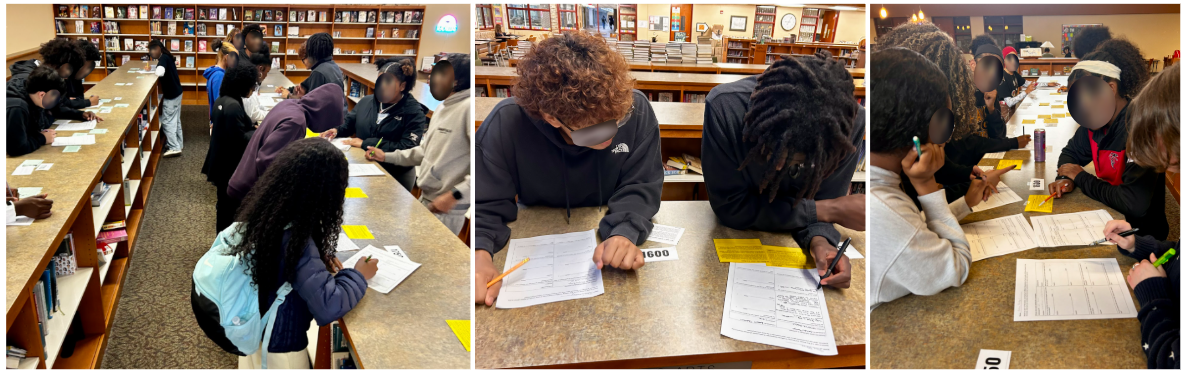
Day #1 Lesson Plan
Before class/set up: I actually got permission to use a space in our school media center. The half-shelving units were a fantastic height for investigation and note-taking. However, it worked well enough in my classroom when I set up my desks in two long rows. One row for “Historical Events” and one row for “Laws and Decrees.” (Students will place their “Individual Cards” on the “Laws and Decrees” row when we get started in class.)
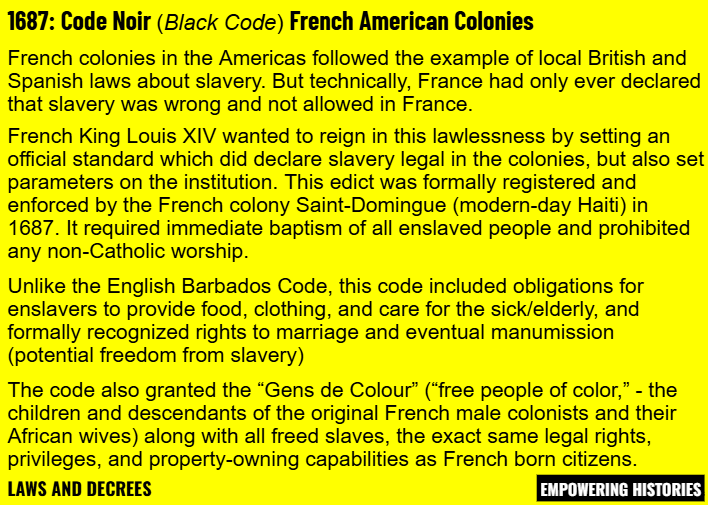
Printing: I used three different colors of paper (pg. 1–4 for “Historical Events” on one color, 5–8 for “Individuals” on another color, and 9–13 for “Laws and Decrees” on the last color). Then I cut the squares using the school’s paper cutter. Also, print a student handout for each student.
Tape the date cards to the table or desks (pg. 15–16) an equal distance apart. I only used the dates 1450 to 1800. (More dates are included because I will continue building on the timeline throughout the year.) I taped the “Legal Context” (pg. 14) paper just to the left of 1450 and instructed students to make sure they checked out the basics of slavery and Roman law to get a baseline understanding of the European legal basis for slavery.
Class - Step #1 - Introduction (12–15 minutes): Go through slides 1–29 with students (that sounds like a lot, but they go quickly. Students can follow along on the handout and will only write a few words down). Don’t get stuck on these. Students will likely want immediate answers to their questions or insights. I mostly respond with: “Hmmm…interesting…I wonder?…we are going to investigate that.” And then keep moving!
The slides start with Juan Garrido's petition, in which he refers to himself as a “black resident of Mexico City.” The question is, what did “Black” mean to Garrido? What did it mean to the King? I prompt students to think about the purpose for writing the document (good DBQ SPY analysis skill practice for the “Y” point). Garrido is listing all the reasons why he deserves payment and land for his service. What did Garrido want the King to do with this information? Garrido is making an argument about what he deserved. He starts that argument by introducing himself as “Black.” Did this refer to his status? His “race”? Or just his phenotype? Without answering all of that for them, I tell them that this is what we will investigate over the next couple of days.
The rest of the slides introduce the fact that race is not a biological reality and that there is more diversity in human DNA within Africa than there is in all of the rest of the continents combined. This refers back to the earliest concepts in the course from Unit 1, that Africa is the birthplace of humanity. The slides also define phenotype and introduce Dr. Barbara Fields, an expert on the history of race creation in the Americas.
Step #2 - Introduction to the Timeline (5–7 minutes): Students should be in pairs. Distribute the Individual Profile cards (there are 16 of these). Have students read for basic information and then fill out the corresponding section on the handout. When finished, one partner should be selected to tape their individual's card on the timeline while the other partner prepares to share with the class. This needs to be pretty snappy, or else it drags on.
Step #3 - Students Share an Individual’s Story (8–10 minutes): In 30 seconds: Your person’s name. Where they lived. Make sure to include the European nation that controlled the colony (e.g., the Portuguese colony of Brazil, the British colony of Virginia, etc.), and then briefly explain the person’s status or how that status changed over time in the New World.
Have students share in chronological order of their individuals.
As students are sharing, the rest of the class should write down a few brief notes. They don’t need every detail, but should capture some observations.
Step #4 - Brief Whole-Class Discussion (5 minutes)
What do you observe about the range of individuals’ stories and their status?
Did you notice any trends? Similarities? Differences? Repeated patterns?
Questions?
Step #5 - Laws and Decrees (8–10 minutes): Introduction to Laws and Decrees. Repeat Step #2, but with different cards. Students should answer the question about their law or decree and then place it on the timeline.
Day #2 Lesson Plan
This was my favorite day. Turn the students loose and let the investigations begin!
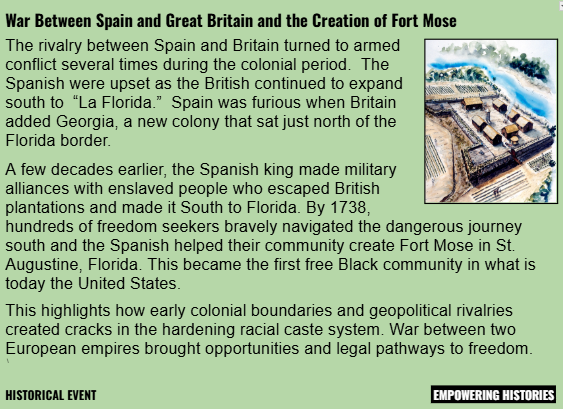
Set up and printing: Before class, place the Historical Events cards on the timeline. Also, reprint and cut more Individuals cards and spread them out on a table (make 2 or 3 of each).
Warm-Up (5 minutes): I give students a few minutes to review their individuals and law code that they wrote about the day before.
Activity and Investigation (50 minutes): Allow the students to choose two different individuals to investigate. Follow the instructions on the handout. Students explore the timeline and will have to choose two historical events and one law code that had the biggest impact on their individual’s life and status in the Americas. They also have to think about what future impact their person or their historical situation had on a later event.
The next part is where they really start making connections, and a few more may need assistance getting started.
For each of the other individuals that they choose for the front side of the handout, they have to get a little creative. Students have to imagine how their life, experiences, and status would have been different had they been brought to a different colony or been born in a different time period between 1500 and 1800. This forces students to grapple with the fact that our modern concepts of “race” and status were never set in stone or predetermined. The process of race invention was a messy process. Understanding this allows our students to see race for what it really is.
* If you are running short on time, you could skip the warm-up, and rush the investigation and only give them 30 minutes and then leave 20 minutes for a refelction converstaion at the end. However, I loved every minute of the extended investigation and was able to engage in so many insightful small group conversations, and I also like to have as much time as needed for the big class discussion the next day.
(OPTIONAL) Day #3 Lesson Plan
Class Discussion (25-55 minutes…with one of classes, 25 minutes was enough, for another section it was 45, and another section went strong for 55 and several students stuck around after the bell to get in one more question!) On the next day, my students have a graded “Cards of Opportunity” discussion. I have all of their names on notecards, and I draw them from a deck. When their name is called, they have to share something that stuck out to them about the timeline, race, status, and colonial American history. They can also choose to share their ideas about how one individual’s life and status would have been different somewhere else or in a different decade in colonial history.
My students had so much to say, and honestly, this is one of those class conversations that can bring the goosebumps. I’m not a teacher who has a “snapping fingers” custom for when someone has a good point in class. But in all three of my sections, the conversation was so good and the thoughts so deep that there was involuntary affirmative finger-snapping all day long!
I end class with a few expert opinions from Clint Smith and Ibram X. Kendi.

*ALSO! I am convinced that there are many different ways to use these materials, and I love to hear new ideas if you try it and modify it in a unique way!
Adding to the Timeline throughout the Semester
At the end of the timeline cards document, I have included some summaries I plan to add to the timeline and bring up as we continue our investigation of enslavement, freedom, and resistance. Here are some of the events I plan to add and have the students discuss:
1776: The Declration of Independence & Dr. Fields analysis of the impacts and solification of race in U.S. society
1789: The US Constitution, Article I, Section 2, Article I, Section 9, Article IV, Section 2
1791-1804: Haitian Revolution
1808: U.S. Law: Act Prohibiting Importation of Slaves
1815: Cotton replaces tobacco as the USA’s most valuable cash crop
1831: Nat Turner’s Rebellion
1837: Senator John C. Calhoun of South Carolina argues that slavery is morally good
1844: Slavery and Black people banned from Oregon Territory
1857: Supreme Court Justice Roger B. Taney, Opinion on Dred Scott v. Sanford, 1857