
TOPIC 4.6 Major Civil Rights Organizations
Mississippi Freedom Summer: SNCC Strategizing Meeting + Seminar
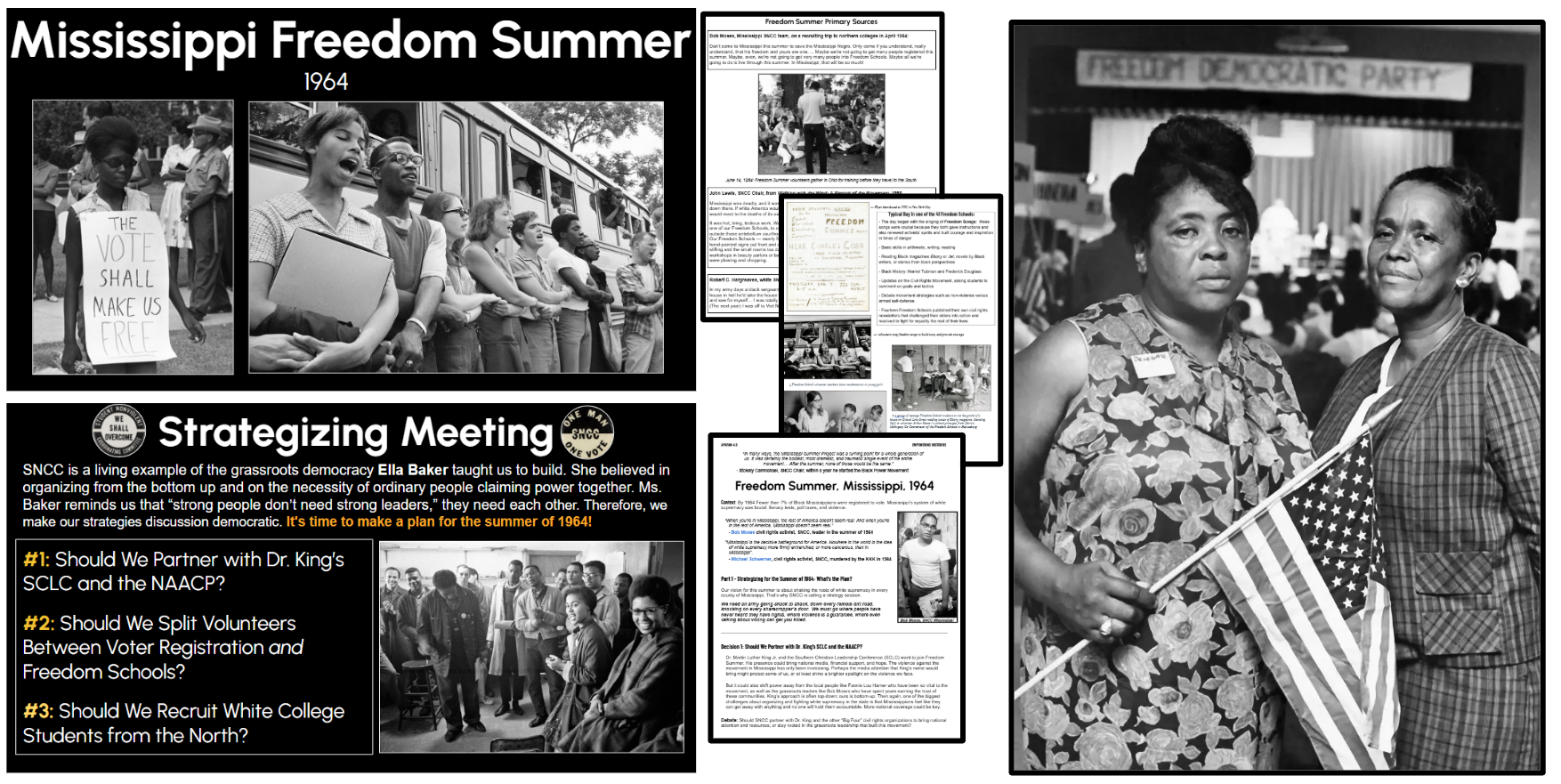
“In many ways, the Mississippi Summer Project was a turning point for a whole generation of us. It was certainly the boldest, most dramatic, and traumatic single event of the entire movement… After the summer, none of those would be the same.”
- Stokely Carmichael, SNCC Chair
EK 4.6.B.3 The Mississippi Freedom Summer project (1964) highlighted the racial violence African Americans faced while trying to assert their constitutional right to vote…41 Freedom Schools…civic activism through voter registration and a celebration of Black history…and the formation of the Mississippi Freedom Democratic Party.
Objective: Students will analyze primary sources from the Mississippi Freedom Summer to understand the methods of major civil rights organizations and evaluate the effectiveness and limitations of different strategies for Black liberation.
Supplies / Preparation
Print page 1-2 (back to back), for every student to pick up on their way into class
Print page 3-8 (back to back, stapled), for every student, but keep these with you until students have started the activity
Lesson Plan
Preview / Introduction (3 Minutes)
As I welcome students into class I ask them to raise their hands and volunteer examples of all the major events in the Civil Rights movement that they can name. (Someone surely will ask if I mean in unit 4 or “does earlier count too?” To which I answer, great question! But that is a different lesson). After listing 8–10 examples, ask: Which state has the highest percentage of Black residents? The answer is Mississippi, and this has been true for at least 150 years. My students never list an event in Mississippi for the first question, if they do mention an event, it will be the lynching of Emmett Till or assassination of Medgar Evers (maybe the Freedom Rides). As we move into 1964, why do you think the state with the highest Black population has not been the center of major, nationally recognized civil rights campaigns?
Context for Freedom Summer (7 Minutes)
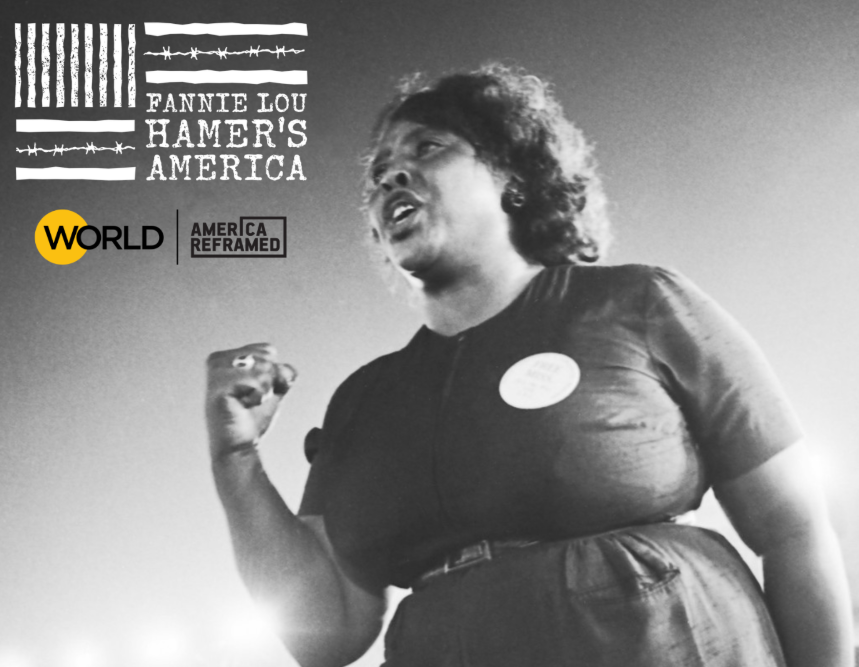
Introduction to Freedom Summer, slides 2-5 (we already discussed Medgar Evers as part of our context to the March on Washington which we covered a few days prior). For slides 6 and 7 play this 2 minute and 40 second clip from Fannie Lou Hamer’s America. (a two page oral interview with Fannie Lou Hamer is included in the “extra primary sources” tab.)
Slides 8–9: Briefly explain the Freedom Vote of 1963 and the creation of the Mississippi Freedom Democratic Party as a challenge to the all-white Mississippi Democratic Party.
This leads into Slide 10, which sets up the small-group “SNCC strategy meeting.” You may want to briefly review the origins of SNCC and how it differed from groups like NAACP and SCLC, especially its focus on grassroots organizing and a more democratic, bottom-up decision-making process. Therefore, like SNCC, students will make decisions by voting.
Mini-SNCC Strategy Meeting Simulation and Discussion (10-12 Minutes)
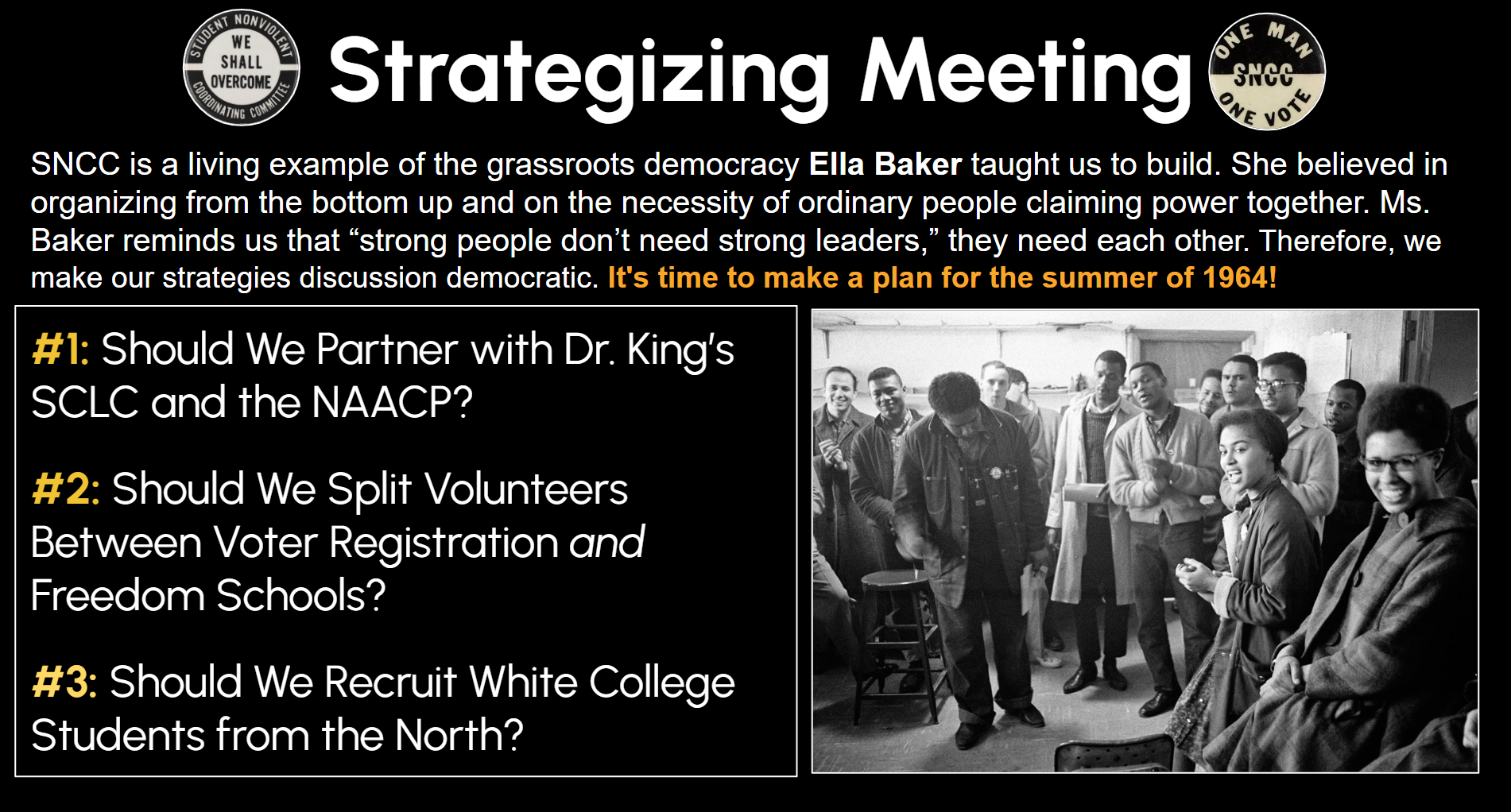
Put students in groups of 5 (an odd number is helpful so that there are no ties in voting).
Rules for discussion. Students should read each of the 3 scenarios. Everyone in the group must give their opinion along with their vote for each of the three decisions.
All group members should mark down the final group decisions. When they have discussed and voted on all three, they should raise their hand. I go over to the group and choose a student at random to briefly explain the three decisions their group made. I then ask that student if they agree about these decisions with a quick follow up of “why?” If the student struggles to respond, I tell the group they need to discuss a little more and that I will come back. This helps the group keep each other accountable during discussion. (That whole interaction will only take about 45 seconds). I then give each group member part 2 (handout pages 3-8, part 3 is also included in these pages).
Historical Notes on “SNCC Strategizing Meeting”
Decision 1 was not a major part of the debate in 1963, as Bob Moses had already resurrected COFO in late 1962 in preparation of the Freedom Vote in 1963. However, this is included in the simulation to get students thinking about the relationship between “The Big Four” and to add emphasis on how the Freedom Summer was a collaborative effort.
Check out this fantastic resource from the SNCC digital archives (link) about strategizing for Freedom Summer. Meeting minutes and an audio file from Bob Moses is fascinating. The student discussion handout includes some screen shots from the actually meeting minutes.
Part 2: What actually happened? What did SNCC actually decide? - Students Review Primary Source Materials and Discuss (15 mins)
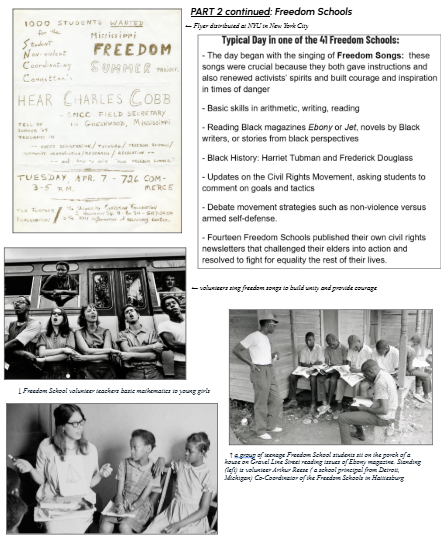
In their group students should review the second source summaries of the actual decisions that SNCC (COFO) made about Freedom Summer and compare SNCC decisions to their own group decisions (page 3 handout). Next students should read the quotes and review the images from Freedom Summer and Freedom Schools (page 4 & 5). When students have reviewed the questions they should raise their hands again. I will spend a little more time in this breakdown (about 2 minutes). I will question two different students and ask 2 of the 6 part 2 questions. For this round, I will allow students to get help from the group before I walk away and tell students to rediscuss. However, the student who needs to “phone a friend” will have to answer the next question. When the group “passes” this check in, I tell them they have completed part 2 and they can begin to prepare for the upcoming Socratic Seminar which will cover the final outcomes and their reflections on Freedom Summer.
Part 3: Students read pages 6-8 and learn the outcomes, the human cost, and the political impact of Freedom Summer (rest of class)
Students have the rest of class to prepare for the Socratic Seminar which will be held 2 days later. (The day in between this activity and the seminar, we will be working on something else. The extra day just gives students time to prepare, especially if we run out of time for them to review pages 6-8 in class on this day.)
The discussion is always excellent. Freedom Summer has so many lessons to uncover and dissect!